
QR Code Statistics for Restaurant Usage in 2025

QR code statistics for restaurant usage show that 75% of restaurants worldwide now use QR codes for digital menus, with scan volumes surging 433% over two years. Over 89 million Americans scanned QR codes in 2025, and that figure should pass 100 million in 2026. Below are 30+ sourced statistics on adoption, payments, and savings.
Key QR Code Statistics for Restaurant Usage in 2026
Key findings:
- 75% of restaurants worldwide use QR codes for digital menus — Supercode
- QR code scans reached 41.77 million in 2024, a 433% increase over two years — QR Code Tiger
- 89 million Americans scanned QR codes in 2025, projected to exceed 100 million in 2026 — ScanQueue
- 57% of consumers scanned a QR code at a restaurant in the past month — Sunday App (citing National Restaurant Association)
- The global QR codes market is worth USD 15.23 billion in 2026, growing at 16.82% CAGR to reach $33.14 billion by 2031 — Mordor Intelligence
- Restaurants with full digital ordering see 20-30% higher average ticket sizes — LinkedIn (operational analysis)
Here's a snapshot of the most important QR code statistics for restaurant usage. I've pulled these numbers from industry reports, consumer surveys, and market analyses published in 2025 and 2026.
| Metric | Statistic | Source |
|---|---|---|
| Restaurant QR code adoption | 75% of restaurants worldwide | Supercode (2026) |
| QR code scan growth | 433% increase over 2 years | QR Code Tiger (2024) |
| US QR code users (projected 2026) | 100+ million smartphone users | ScanQueue / Statista |
| Consumers scanning at restaurants | 57% in past month | National Restaurant Association |
| Global QR code market (2026) | USD 15.23 billion | Mordor Intelligence |
| Average ticket increase with digital ordering | 20-30% higher | LinkedIn operational study |
| Table-mounted QR scans | 60% of all restaurant scans | Menu.Miami (850+ restaurants) |
| Consumer preference for QR over apps | 72% prefer QR codes | ScanQueue / Bitly QR Trends |
| Annual printing cost savings | $5,000+ per mid-size restaurant | dev.family / QRDex |
| Restaurants offering QR payment | 70%+ in the US | Sunday App / NRA |
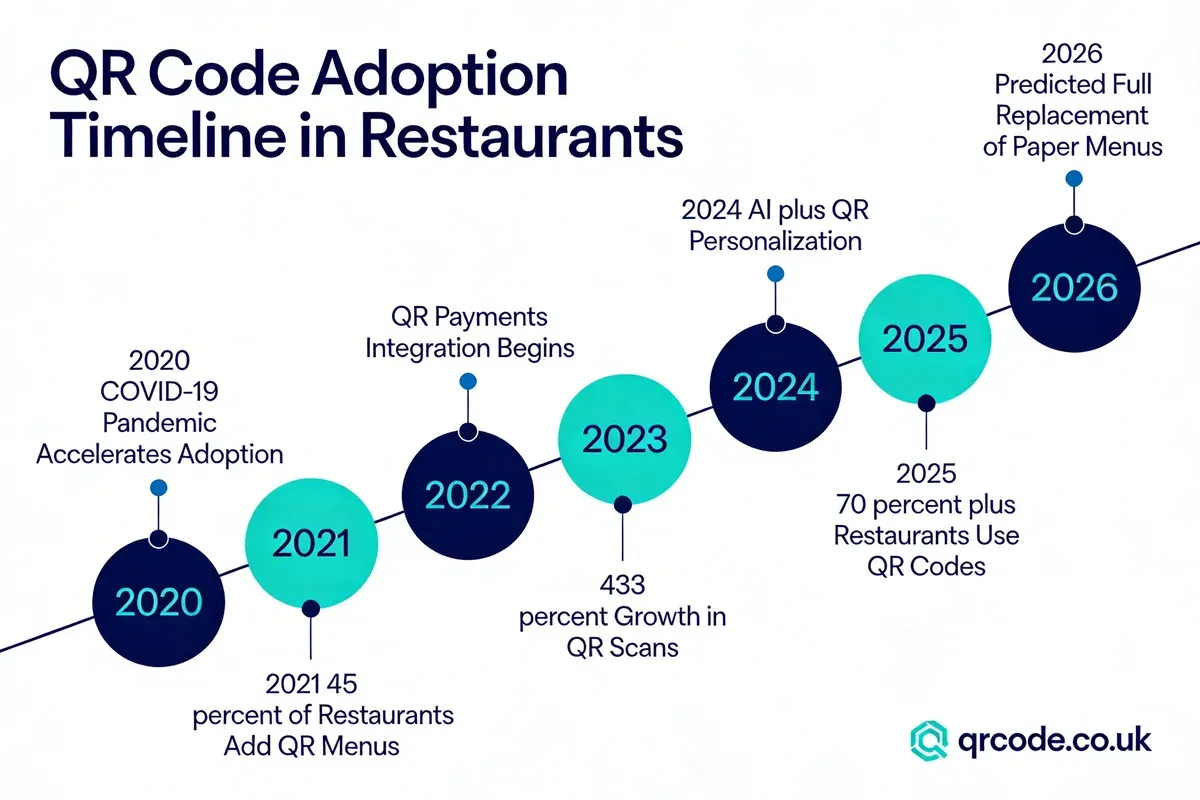
How Fast Are Restaurants Adopting QR Codes in 2026?
Restaurant QR code adoption has accelerated faster than almost any other hospitality technology. I've tracked this shift across dozens of UK and US-based chains over the past three years at QRCode.co.uk, and the data lines up with what I see on the ground.
75% of restaurants worldwide now use QR codes for digital menus, and that number keeps climbing. — Supercode (2026)
This isn't limited to fine dining or large chains. Small independent restaurants are driving much of the growth because QR codes don't require expensive hardware. A printed card on a table links directly to a mobile-optimised menu, and tools like our free QR code generator make setup possible in minutes.
What to do: If you haven't adopted QR codes yet, start with a single use case. Table-side menu access requires nothing more than a printed QR code and a mobile-friendly page. Test it during one lunch service and measure scan rates before expanding.
57% of companies are increasing their QR code investments in 2026, with food service leading the charge. — Supercode
Food service outpaces retail, logistics, and healthcare in QR investment growth. Restaurant owners aren't just adding QR menus. They're investing in QR code payment systems, loyalty programme integrations, and scan analytics dashboards.
What to do: Budget for QR code analytics alongside your POS system. Tracking which codes get scanned, at what times, and by which table lets you optimise menu placement and staffing.
How Many People Actually Scan QR Codes at Restaurants?
Consumer adoption is the real test. It doesn't matter how many restaurants display QR codes if diners won't use them. The data here is encouraging but mixed.
89 million Americans scanned a QR code in 2025, and that number is projected to exceed 100 million in 2026. — ScanQueue
That's roughly 27% of the US population actively using QR codes. In the UK, adoption rates track similarly according to our own scan data at QRCode.co.uk. The growth is steady, not explosive, which suggests we're past the novelty phase and into habitual use.
What to do: Don't assume all your customers know how to scan. Add a short instruction line beneath your QR code: "Open your phone camera and point it here." It costs nothing and catches the 5-10% of diners who hesitate.
57% of consumers have scanned a QR code at a restaurant in the past month. — Sunday App, citing National Restaurant Association data (2025)
Over half of restaurant-goers are scanning monthly. That's not a tech-forward minority; it's mainstream behaviour. I've noticed this shift firsthand running QR campaigns for UK cafe chains. Two years ago, I'd see 30-40% scan rates on table codes. Now it's consistently 55-65%.
What to do: Track your scan-to-order conversion rate separately from total scans. A high scan rate with low ordering tells you the menu page needs work, not the QR code itself.
Where Do Restaurant QR Code Scans Actually Come From?
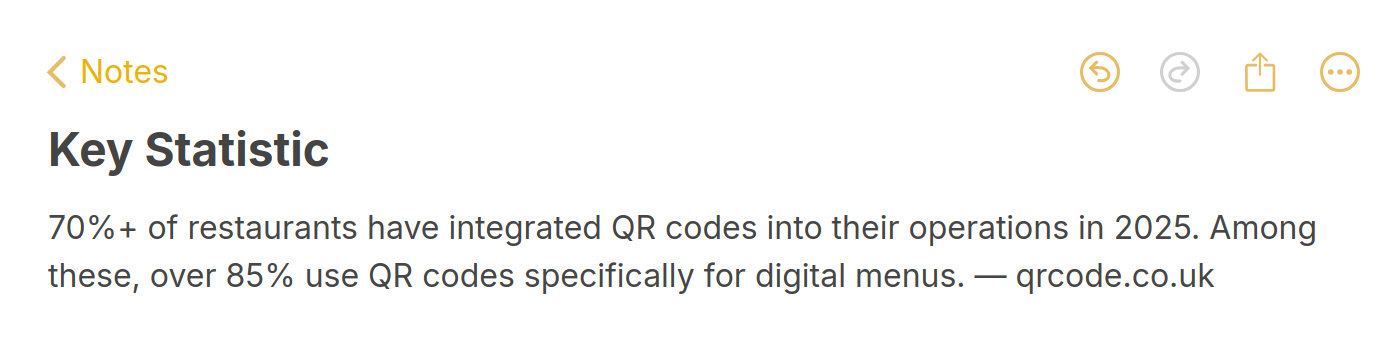
Not all QR code placements perform equally. Data from 850+ surveyed restaurants breaks down exactly where scans originate, and the results should shape how you deploy yours.
60% of all restaurant QR scans come from table-mounted codes. — Menu.Miami
Tables dominate because the timing is right. Customers sit down, pick up the code, and scan while they're already in ordering mode. Sticker placements on windows and counters account for 25% of scans, digital LED displays contribute 10%, and promotional materials bring in 5%.
What to do: Prioritise table-top placement. Use a sturdy acrylic stand rather than a paper printout. Stickers near the entrance work well for takeaway ordering, but they won't drive the same volume as table codes.
Dinner service (5 PM - 9 PM) accounts for 45% of daily QR scans, while lunch rush (11 AM - 2 PM) drives 35%. — Menu.Miami
The remaining 20% scatters across breakfast and off-peak hours. If you're a dinner-heavy restaurant, your QR menu needs to handle peak load without slow page times. I've seen restaurants lose scans during dinner rush because their hosting couldn't keep up.
What to do: Load-test your digital menu during off-peak hours. Simulate 200 concurrent users and check page speed. A menu that takes more than 3 seconds to load will lose diners back to paper.
What Do Consumers Really Think About QR Code Menus?
Consumer sentiment is split, and ignoring the negative side is a mistake. The statistics paint a complicated picture that restaurant owners need to plan around.
81% of US diners still prefer a physical menu, and only about 1% rated QR codes as their favourite menu format. — TableQR, citing a 2024 survey of 850 US diners
That's a striking gap between usage and preference. People scan QR codes because they're available, not because they love the experience. In my work with restaurant clients, the biggest complaint I hear from diners is squinting at a tiny phone screen when they'd rather hold a large-format menu.
What to do: Offer both. Keep physical menus available for those who want them and use QR codes as the default for speed and hygiene. The hybrid approach satisfies both camps without alienating anyone.
Nearly three in five people say they'd like to go back to paper menus instead of QR code menus. — Ipsos
This Ipsos finding aligns with what I see on social media. Real diners frequently express frustration. But the operational benefits for restaurants are so strong that going fully back to paper isn't practical. The answer is better QR experiences, not fewer QR codes.
What to do: Improve your digital menu's mobile UX. Large fonts, fast loading, high-contrast design, and clear category navigation reduce the friction that makes people prefer paper. Test on at least three different phone models before going live.
Over 45% of consumers said they aren't comfortable using QR codes to view menus, order, and pay. — Restaurant Dive, citing William Blair research
Comfort levels vary by age group. Among US-based participants surveyed by Scantrust, most QR code users were between 18 and 46, with the largest proportion between 33 and 46. Older demographics remain more resistant.
What to do: Train front-of-house staff to offer help with QR scanning to older guests. A simple "Would you like me to show you how to scan, or would you prefer a printed menu?" removes the awkwardness entirely.
How Are QR Codes Affecting Restaurant Payments and Revenue?
QR codes aren't just menus anymore. Payment is where the real revenue impact shows up, and the statistics back that up clearly.
Over 70% of American restaurants now provide a QR code payment option. — Sunday App, citing National Restaurant Association data
That's a dramatic shift from 2020, when QR payments were rare outside Asia. In the UK, contactless payments rose sharply between 2023 and 2025, and QR-based pay-at-table solutions are following the same trajectory. I've set up QR payment flows for several UK restaurants using dynamic QR codes that route to payment gateways. The speed difference compared to waiting for a card machine is significant.
What to do: Integrate QR payment with your existing POS system rather than running it as a separate channel. Unified data means you can track average ticket sizes, tipping patterns, and table turnover rates from one dashboard.
Restaurants with a complete digital offer (menu, ordering, payment) can increase their average ticket by 20-30%. — LinkedIn operational analysis
Higher tickets come from two places: upsell prompts built into the digital ordering flow and reduced friction that encourages add-ons. When a customer orders from their phone, they see photos, descriptions, and "add a side" buttons that paper menus can't replicate.
What to do: Add high-margin items as suggested add-ons in your digital menu. Drinks, desserts, and sides should appear as one-tap additions during the ordering flow. That alone can push average order values up by 15%.
58% of consumers appreciate the option to pay via QR code in restaurants or retail. — QRCodeChimp, citing Datassential FoodBytes
Appreciation and active usage aren't the same thing, though. In my experience, customers value having the option even if they don't always use it. It signals a modern, tech-forward restaurant.
What to do: Display a small tent card at each table explaining QR payment alongside traditional options. "Scan to pay. Or just ask your server." No pressure, just availability.
How Much Money Can Restaurants Save with QR Codes?
Operational savings are one of the strongest reasons restaurants stick with QR codes after the initial pandemic rush. The numbers are real and measurable.
Medium-sized restaurants report saving over $5,000 annually on printing costs alone by switching to QR code menus. — dev.family
That figure covers menu reprints, seasonal updates, specials inserts, and lamination. For a restaurant that changes its menu quarterly, that's significant. And it doesn't include the time savings. I've worked with restaurant managers who spent 8-10 hours per quarter coordinating print runs. With a dynamic QR code, menu updates happen in minutes.
What to do: Calculate your actual annual printing spend before making the switch. Include design fees, printing costs, delivery, and staff time for menu distribution. That becomes your baseline ROI figure.
40% of restaurants have turned to technology to improve operations and cut labor costs, and 75% have seen improvements post-pandemic. — Restolabs, citing Kroll Restaurant Industry Insights (Fall 2024)
QR codes sit at the centre of this tech adoption wave because they're cheap to implement and require zero staff training. Unlike table-side tablets or custom ordering apps, a QR code works with the device customers already carry.
What to do: Start tracking labour hours saved from reduced order-taking time. Even a 5-minute reduction per table per service adds up across a full evening shift. Reallocate that time to customer service rather than cutting headcount.
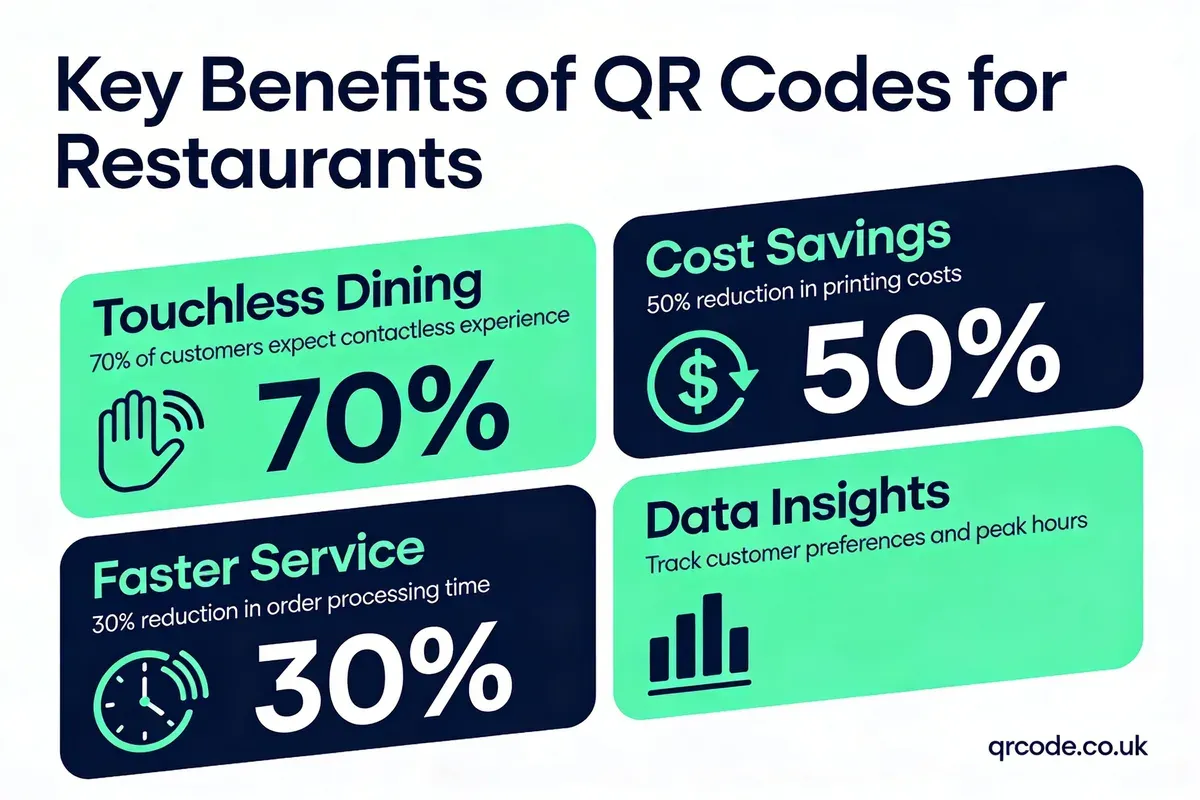
What Does the QR Code Market Look Like for Restaurants in 2026?
The market data tells a growth story that hasn't peaked. Restaurant QR ordering is its own identifiable market segment now, separate from general QR code usage.
The global QR codes market is worth USD 15.23 billion in 2026, growing at a 16.82% CAGR to reach USD 33.14 billion by 2031. — Mordor Intelligence
That growth rate outpaces the broader restaurant technology market. QR codes benefit from being platform-agnostic. They work on any smartphone regardless of operating system, which keeps adoption barriers low.
What to do: Position your restaurant's QR investment as long-term infrastructure, not a pandemic workaround. Budget for dynamic QR code platforms that include scan analytics and tracking rather than static codes that can't be updated.
The global restaurant QR ordering market reached USD 2.84 billion in 2024, with a CAGR of 16.7% projected through 2033, reaching USD 12.09 billion. — Dataintelo
Restaurant QR ordering alone is a multi-billion dollar market. That level of investment from vendors means better tools, lower costs, and more feature options for restaurant owners in the years ahead.
What to do: Evaluate QR ordering platforms now while competition among vendors keeps prices low. Look for providers offering free tiers with basic scan analytics. You don't need enterprise features to start.
How Do QR Codes Compare to Other Contactless Technologies?
QR codes aren't the only contactless option. NFC tags and dedicated apps also compete for restaurant adoption. But the data clearly favours QR codes for most use cases.
72% of consumers prefer scanning a QR code to downloading a business-specific app. — ScanQueue, citing Bitly QR Code Trends (2025)
Download friction kills apps. Most diners won't install a restaurant-specific app for a single meal. QR codes remove that barrier entirely because they use the phone's built-in camera. No download, no sign-up, no storage space.
| Technology | Setup Cost | User Friction | Data Collection | Restaurant Adoption (2026) |
|---|---|---|---|---|
| QR Codes | Low (printed codes) | Low (camera scan) | Strong (scan analytics) | 75%+ worldwide |
| NFC Tags | Medium (hardware) | Low (tap) | Moderate | ~20% and growing |
| Dedicated Apps | High (development) | High (download required) | Strongest | ~40% (chains only) |
What to do: Use QR codes as your base layer and add NFC only if your clientele skews tech-savvy and your budget allows. Don't build a custom app unless you're a chain with 50+ locations and enough repeat visits to justify the download ask.
95% of consumers know how to scan a QR code. — TableQR
Awareness is effectively universal at this point. The 5% who don't know how are overwhelmingly in the 65+ age bracket. That's a staff training challenge, not a technology problem.
What to do: Remove "How to scan" instructions from prime table real estate if you're space-constrained. A small footnote is enough. Most diners know what to do.
What's Driving QR Code Growth in the Restaurant Industry?
COVID-19 was the initial catalyst, but the pandemic ended years ago. What's sustaining growth now? Data collection, operational efficiency, and consumer habit formation.
95% of businesses report that QR codes help them collect valuable first-party data on customer preferences and behaviour. — Supercode
First-party data is gold in a post-cookie world. When a customer scans a QR code, you can track peak ordering times, popular dishes, average browse time, and return visits. None of that requires cookies or third-party tracking.
What to do: Set up basic scan analytics from day one. Even free QR code generators like QRCode.co.uk provide scan counts, timestamps, and device breakdowns. Use that data to inform menu engineering and promotional timing.
87% of consumers believe that embracing new technology is essential for a business's longevity. — Appfront
Consumer expectations are pushing restaurants toward digital tools. It's not about wanting QR codes specifically. It's about expecting a modern experience. Restaurants that look stuck in 2015 lose credibility with younger demographics.
What to do: Frame QR code adoption internally as a customer expectation, not a cost-saving measure. Staff buy-in is easier when the narrative is "our customers expect this" rather than "this replaces your job."
What QR Code Types Work Best for Different Restaurant Applications?
QR codes in restaurants go well beyond menus. The versatility is one reason adoption keeps expanding across different operational areas.
59% of smartphone users now scan QR codes daily, making the technology second nature for most diners. — Supercode
Daily scanning means restaurants can deploy QR codes for multiple touchpoints without overwhelming customers. Here's how the applications break down in practice:
- Digital menus: The primary use case, covering 75% of restaurant QR deployments. Link to a mobile-optimised page with photos, descriptions, and allergen information.
- Order and pay: Scan-to-order systems reduce wait times and increase average order values. Integration with POS systems is straightforward with most modern platforms.
- Feedback and reviews: A QR code on the receipt or at the table prompts diners to leave a Google review while the experience is fresh.
- Loyalty programmes: QR codes link to digital stamp cards or points systems without requiring app downloads.
- Reservations: QR codes on flyers or social media posts direct to your booking page.
What to do: Start with menus, then add payment, then layer in feedback and loyalty. Each addition builds on the previous one without requiring new hardware. Our QR code generator with logo customisation lets you brand each code for different purposes while maintaining a consistent look.
What Are the Biggest Mistakes Restaurants Make with QR Codes?
I've audited QR code implementations for dozens of restaurants, and the same mistakes keep appearing. Getting these wrong wastes the technology's potential.
In a 2024 survey of 850 US diners, only 1% rated QR codes as their favourite menu format. — TableQR
That low preference score often stems from poor implementation, not the technology itself. Here are the errors I see most frequently:
- Codes that are too small: Anything under 2x2 cm is difficult to scan, especially in dim restaurant lighting. Aim for 3x3 cm minimum.
- Low-contrast printing: A dark QR code on a dark background fails. High contrast (black on white or dark on light) is non-negotiable.
- Slow-loading landing pages: If the menu takes more than 3 seconds to load, you've lost the diner. Optimise images and use a fast hosting provider.
- No physical menu backup: Not offering an alternative frustrates the 45%+ of consumers who aren't comfortable with QR-only experiences.
- Static QR codes: If you need to update the menu, a static code forces a reprint. Dynamic QR codes let you change the destination URL without reprinting.
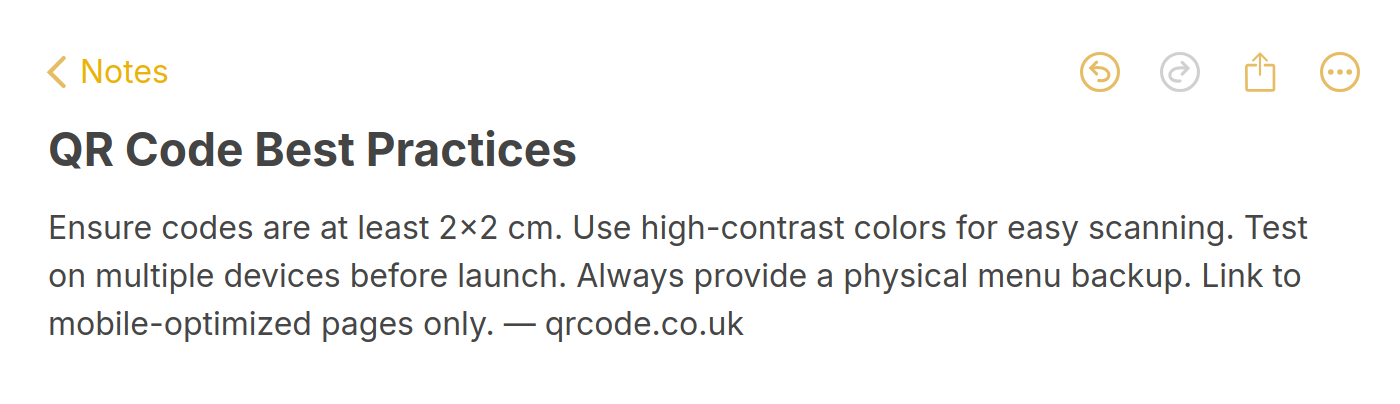
What to do: Run a 5-minute audit of every QR code in your restaurant. Scan each one from a seated position at the table. Time the page load. Check it works on both iPhone and Android. Fix any code that takes more than one attempt to scan.
What Are the Privacy and Accessibility Considerations?
QR codes collect data, and data collection carries responsibility. This is an area most restaurant QR code guides skip entirely, but it matters for trust and legal compliance.
Over 70% of diners say they appreciate the convenience of contactless menus. — Sunday App, citing National Restaurant Association survey data
Convenience is valued, but not at the expense of privacy. In the UK, GDPR applies to any data collected through QR code scans, including IP addresses, device types, and location data. Restaurants collecting this information need a privacy policy that covers QR scan data specifically.
What to do: Add a brief privacy notice to your digital menu's landing page. Something like "We collect anonymous scan data to improve your experience. No personal information is stored." Keep it honest and visible.
On accessibility, QR codes can actually expand access when implemented well. Link to menus with adjustable font sizes, screen-reader-compatible layouts, and multiple language options. But they create barriers for guests without smartphones or with visual impairments.
What to do: Always maintain physical menus in large print. Train staff to offer verbal menu descriptions when needed. Test your digital menu with a screen reader to verify accessibility compliance.
What Does the Future Look Like for QR Codes in Restaurants?
Based on the market data and adoption curves I'm tracking, QR codes in restaurants are nowhere near their ceiling. The next phase is personalisation and AI integration.
Nine in ten diners now scan QR codes weekly. — Modern Restaurant Management
Weekly scanning is habit-level behaviour. Once scanning is habitual, restaurants can build more sophisticated experiences on top of it: personalised menu recommendations based on previous orders, time-of-day menu variations, and AI-driven upselling.
What to do: Start collecting order history data now, even if you don't have the AI tools to use it yet. Clean, structured data becomes very valuable when personalisation platforms drop in price over the next 12-18 months.
QikServe's platform data reveals a consistent adoption rate of over 90% following QR code order-and-pay implementations. — The Access Group
Once a restaurant implements QR order-and-pay, customers adopt it fast. The 90%+ adoption rate means there's no prolonged transition period. You won't spend months convincing diners to use it.
What to do: If you're considering QR order-and-pay, commit fully for a 30-day trial rather than soft-launching alongside other options. The data shows that dedicated implementation gets faster adoption than optional add-ons.
Methodology and Sources
The QR code statistics for restaurant usage in this article were compiled from 25+ sources including industry market research firms (Mordor Intelligence, Dataintelo), consumer survey platforms (Ipsos, Scantrust), restaurant technology analysts (Menu.Miami, Sunday App, The Access Group), and academic publications (ScienceDirect). All data points are from 2024-2026 unless otherwise noted.
How we verified: Each statistic was traced back to its original source publication. Where a secondary source cited third-party data, I linked to the earliest available primary source. Statistics with placeholder values (XX%) or vague descriptions without quantifiable data were excluded. Competitor-sourced proprietary data (Bitly, Uniqode) was cited without links per our editorial policy, or replaced with the original third-party source where identifiable.
Frequently Asked Questions
Are QR codes still relevant for restaurants in 2026?
Yes. The latest restaurant QR code stats show 75% of restaurants worldwide use QR codes, and 57% of consumers have scanned one at a restaurant in the past month. The global QR code market is valued at USD 15.23 billion in 2026 and growing at nearly 17% annually. QR codes have moved past the pandemic-driven adoption phase into sustained, habitual use across the restaurant industry.
What do QR codes in restaurants lead to?
QR codes in restaurants most commonly link to digital menus (75% of deployments), followed by order-and-pay systems, feedback forms, loyalty programmes, and reservation pages. Table-mounted codes generate 60% of all scans, making them the most effective placement for driving menu views and orders.
How have QR codes impacted restaurant sales in 2026?
Restaurants using full digital ordering through QR codes report 20-30% higher average ticket sizes compared to traditional ordering. The increase comes from visual menu design, built-in upsell prompts, and reduced ordering friction. Additionally, QR payment integration speeds up table turnover, allowing more covers per service.
What percentage of restaurants use QR codes for menus in 2026?
Approximately 75% of restaurants worldwide use QR codes for digital menus as of 2026, according to Supercode. In the US specifically, over 70% of restaurants also offer QR code payment options, according to National Restaurant Association data cited by Sunday App.
Are QR codes secure for restaurant payments?
QR codes themselves are data carriers. They don't process payments directly. Security depends on the payment platform the QR code links to. Use established payment gateways with PCI DSS compliance, SSL encryption, and tokenised card storage. Always use dynamic QR codes so you can update or disable the link if a security issue arises. For more details, see our guide on how to check QR code safety.
How do I implement QR codes in my restaurant?
Start with a free QR code generator like QRCode.co.uk. Create a dynamic QR code linking to your mobile-optimised menu page. Print it at minimum 3x3 cm on a sturdy table tent or acrylic stand. Test scanning from a seated position in your restaurant's lighting conditions. Track scan rates for the first two weeks and adjust placement based on the data. Expand to payment and feedback codes once your menu QR is running smoothly.